Cyberpunk 2077: A Poetic Glimpse into Player Folly and Developer Craft
Cyberpunk 2077 Phantom Liberty delivers a thrilling, immersive experience in Night City, blending heart-pounding action with poetic storytelling.
In the sprawling, neon-drenched labyrinth of Night City, where chrome meets soul and every shadow holds a story, the world of Cyberpunk 2077 breathes with a life of its own. The recent expansion, Phantom Liberty, has only deepened its veins, adding layers of intrigue and heartache to an already colossal tapestry. It's a world so vast, so meticulously woven, that one might wonder if its creators, CD Projekt Red, could possibly account for every whimsical, reckless thought shimmering in a player's mind. Yet, as the digital winds whisper through the megabuildings, it becomes clear that the architects of this future are not just builders; they are wry observers, poets of the code, ready to meet folly with a knowing, almost affectionate, smirk.
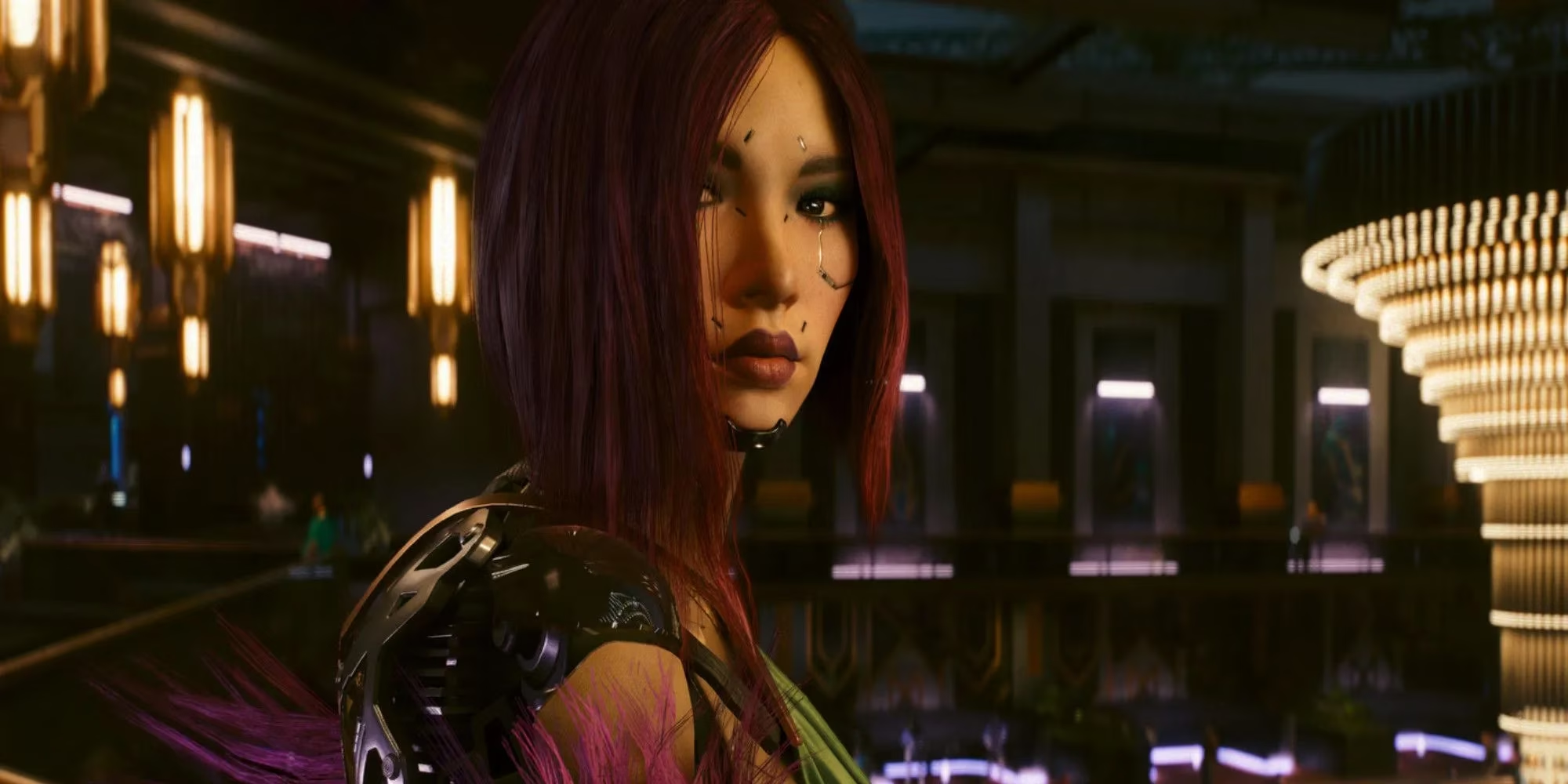
The Call of the Void, and a Rocket's Embrace
There exists a moment, fragile as glass and charged with emotion, where a mercenary named V can offer a final kindness: sending the enigmatic Songbird on a one-way journey to the Moon, a chance at peace far from Earth's chaos. The rocket door seals with a definitive hiss, a period at the end of a sentence of suffering. But in the silent space between closure and liftoff, a player's curiosity—or perhaps sheer audacity—saw not an ending, but an invitation. Prototailz, a denizen of the game's vibrant subreddit, discovered a sliver of reality, a tiny platform on the rocket's exterior, and thought, "Why not catch a ride?" Oh, choom, the nerve of it! The poetry of this attempt is undeniable: a desperate, ill-advised lunge for the stars, clinging to hope (and metal) as it prepares to defy gravity.
The Ghost in the Shell and the Voice of Reason
As the rocket groans to life, beginning its slow pivot toward the heavens, a familiar, grating presence materializes in V's mind. Johnny Silverhand, the rockerboy ghost etched into V's psyche, appears not with a guitar riff, but with the weary tone of a man who has seen this brand of stupidity before. "Where the hell do you think you're going?" he demands, the digital equivalent of a facepalm. V, brimming with the misplaced confidence of someone who hasn't yet grasped the laws of physics—or basic self-preservation—retorts with a bravado that's just... chef's kiss. "Watch the show," they say, as if about to perform a magic trick, not commit spectacular suicide.
Johnny, forever the cynical counterpoint to V's impulsiveness, becomes the chorus to this tragicomic opera. With each shudder of the rocket, his muttered "Oh ..." paints a picture of dawning horror. He's the part of us that knows better, screaming into the void as V, the embodiment of "hold my beer," prepares for launch. The dialogue, though believed to be repurposed from other scenes, fits this unintended scenario with an eerie, hilarious precision. It's less of a bug and more of an emergent sonnet, a duet between reckless ambition and sardonic doom.
The Brief, Fiery Ascent
And then, the moment of truth. V, still clinging to their delusion of a lunar vacation, breathes out a triumphant, "Aaaand whoosh...." anticipating the grand adventure. The rocket ignites, a pillar of fire and fury. What follows is not the silence of space, but a short, sharp symphony of pained grunts—the sound of a body recognizing, far too late, that it has made a catastrophic miscalculation. The dream of standing on the rocket's side, hair streaming in the solar wind, dissolves instantly into a burst of flames. V's final journey isn't to the Moon's silent seas, but to a quickload menu. The ambition was galactic; the outcome was, quite literally, a blaze of glory. Talk about going out with a bang!
| Character | Role in the Scene | Poetic Significance |
|---|---|---|
| V (The Player) | The Reckless Dreamer | Embodies the unyielding, often foolish, human desire to break boundaries and script our own endings, no matter the cost. |
| Johnny Silverhand | The Cynical Chorus | Represents the voice of reason, memory, and consequence, a ghost haunted by the player's present folly. |
| The Rocket | The Ironic Chariot | A vessel of promised salvation for one, and an instrument of instantaneous demise for another. A symbol of paths diverging violently. |
| CD Projekt Red | The Omniscient Bard | The unseen poet who wove the possibility for this folly into the code, then wrote the punchline. |
The Developer's Whisper in the Code
This entire sequence stands as a testament, a love letter to detail from CD Projekt Red. It's them leaning in, a glint in their eye, and whispering to the player, "We see you. We knew you'd try this." In the wake of Cyberpunk 2077's tumultuous launch, Phantom Liberty represents more than just new content; it symbolizes a studio listening, learning, and embedding its hard-won wisdom—and sense of humor—into the very fabric of its world. They didn't have to account for a player trying to surf a rocket to the Moon, but they did. That attention to the edges of possibility, to the corners where players poke and prod, is what transforms a game from a product into a living, breathing universe.
Looking ahead to 2026 and beyond, the lessons are being etched into new blueprints. As the studio turns its gaze to the next saga, perhaps in the wilds of a new Witcher tale, one can sense a commitment to this philosophy. A focus on foundational strength, on anticipating the beautiful, ridiculous things a community might dream up. The call-out to Prototailz's lunar ambition isn't a scolding; it's a shared joke, a moment of connection between creator and consumer in a vast digital space. It's a reminder that in these crafted worlds, even our failures can be memorable, poetic, and strangely glorious. The city dreams, and sometimes, it dreams of rockets and fools, burning bright against the night sky. 🌃🚀💥
Comments