My Top 10 Most Scientifically Accurate Sci-Fi Games That Blew My Mind in 2026
Explore the captivating realm of realistic sci-fi games, where genuine scientific concepts like the zombie ant fungus in 'The Last of Us' and societal extrapolations in 'Cyberpunk 2077' create immersive and thought-provoking experiences.
Let me tell you, as a professional gamer who has explored countless digital worlds, there's nothing quite like the spine-tingling thrill of playing a science fiction game that feels like it could be tomorrow's news! The eternal dance between hard, demonstrable science and wild, speculative fiction creates a spectrum of experiences, from fantastical escapes to sobering reflections of our own trajectory. For us, the eternally curious, the games that anchor themselves in reality—that use genuine scientific concepts as their bedrock—offer a uniquely potent cocktail of education, challenge, and sheer, unadulterated wonder. They don't just let you escape our world; they force you to understand it better, to question it, and to see the terrifying or beautiful seeds of the future sprouting all around us right now. Forget pseudoscience conjured from thin air! The real magic happens when developers have the courage to dive into the technical weeds of physics, biology, and sociology, then blast off into the stratosphere of imagination from there. Buckle up, because I'm about to take you on a tour of the ten most realistic sci-fi games that have absolutely reshaped my perception of what's possible—both in gaming and in our universe.
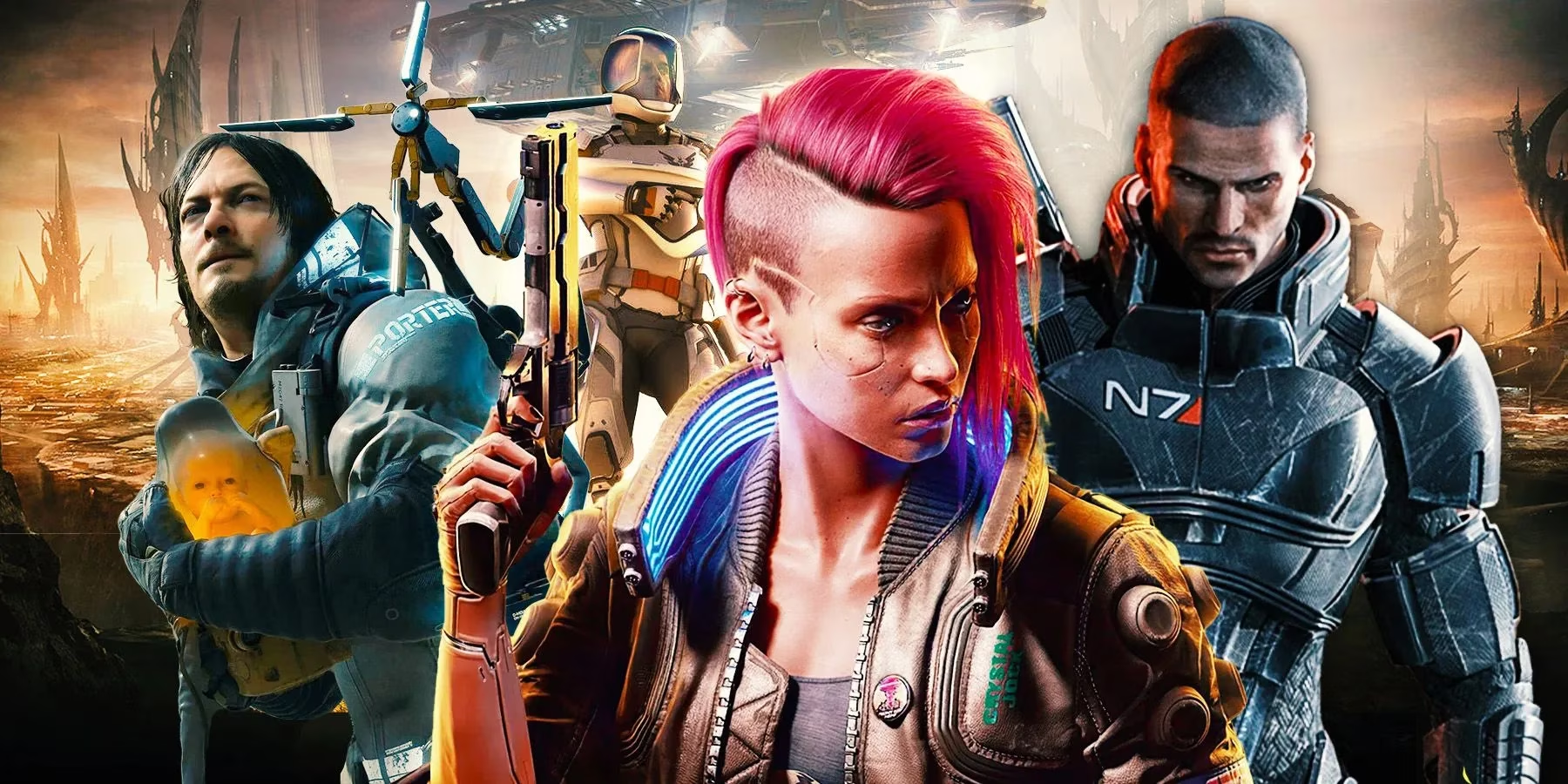
10. The Last of Us: When Fungus Gets Personal (And Terrifying)
I still get chills thinking about it. The Last of Us isn't just a masterclass in storytelling and tension; it's a biological horror story ripped from the pages of a mycologist's journal! The genius—the sheer, terrifying genius—is that the Cordyceps brain infection isn't some made-up monster. It's based on the very real, very creepy Ophiocordyceps unilateralis, the so-called "zombie ant fungus." This thing actually exists! It hijacks an ant's nervous system, forces it to climb to an ideal spot for spore dispersal, and then... well, let's just say the ant's story ends there. Naughty Dog's stroke of brilliance was asking, "What if it could jump species?" 🍄 The result is a pandemic that feels unnervingly plausible, grounding its apocalyptic horror in a chillingly real scientific premise. It’s the perfect gateway into realistic sci-fi: taking one bizarre, true natural phenomenon and following the logical, horrific thread.
9. Cyberpunk 2077: Our Dystopian Tomorrow, Today
Stepping into Night City for the first time in 2026 isn't just immersive; it's a gut punch of recognition. CD Projekt Red didn't just build a city; they extrapolated our worst societal trends into a neon-drenched, hyper-capitalist nightmare. The "accuracy" here isn't about rocket science; it's about social science. The universal Cyberware? We're already implanting chips in our hands. The Inversion Smog choking the streets? A logical extreme of our pollution crises. Megacorporations with more power than governments? Look at the news! The game holds up a distorted mirror to our present, amplifying our addiction to technology, rampant consumerism, and corporate overreach until it becomes a suffocating reality. Playing it feels less like fantasy and more like a warning from a possible, very near future.
8. Mass Effect: Making Theoretical Physics Feel Like Magic
The Mass Effect series is my galactic-scale physics textbook, and I mean that in the best way possible. It doesn't just hand-wave faster-than-light travel; it gives it a name and a (theoretically sound) mechanism: mass effect fields and element zero. This is directly inspired by the real-world theoretical concept of negative mass, a hypothesized substance used to explain dark energy! 🤯 The codex is a treasure trove of these explanations, from ship propulsion to planetary climates. And the aliens? Forget generic humanoids with funny foreheads. The Turians, with their metallic carapaces and dextro-amino acid biology, or the Asari, with their unique reproduction, feel like they evolved on genuinely alien worlds. The Legendary Edition is a must-play, and the hype for Mass Effect 4 is all about seeing where this scientifically-grounded universe goes next.
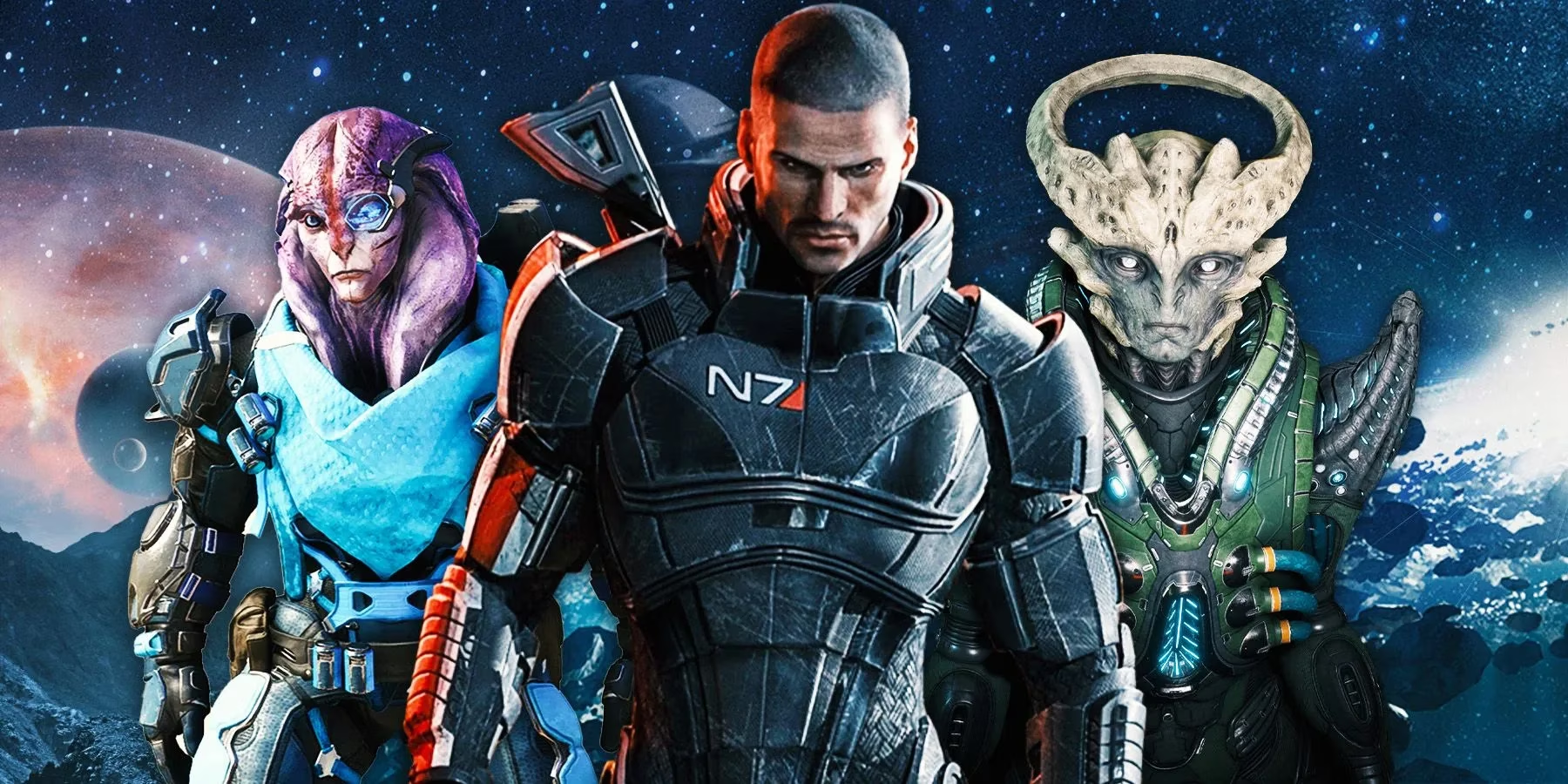
7. Metal Gear Solid 2: The Prophecy We Lived To See
Playing Metal Gear Solid 2 today is a surreal experience. It's less of a "sci-fi" game now and more of a period piece... a period piece that predicted our period with unsettling accuracy. When Hideo Kojima crafted this in 2001, concepts like:
-
Omnipresent, AI-curated information flow (The Patriots' S3 Plan)
-
The erosion of truth by "contextual" data (The Meme, or "scene")
-
The psychological impact of digital life
...were the stuff of conspiracy theory. Now? It's our daily internet existence. The game's central theme—that in the digital age, we are shaped not by the truth, but by the information we are fed—feels more relevant than ever. It predicted the architecture of our social media hellscape and the weaponization of misinformation decades in advance. Talk about accurate futurism!

6. Death Stranding: The "Strand Game" That Stranded Us All
Kojima did it again. Death Stranding launched in late 2019 as a bizarre, beautiful puzzle about connection and isolation in a broken America. Then, months later, a global pandemic locked us all indoors, forced us to rely on delivery networks for survival, and connected us through fragile digital threads. The parallels are staggering. Beyond its eerie predictive social commentary, the game's realism shines in its brutal logistics. The weight distribution on Sam's back actually affects his balance. You must plan routes considering river currents, terrain steepness, and weather. Building structures like bridges and zip-lines uses principles of simple machines. It's a game that makes you feel the very real, very physical cost of reconnecting a shattered world, one carefully planned step at a time.
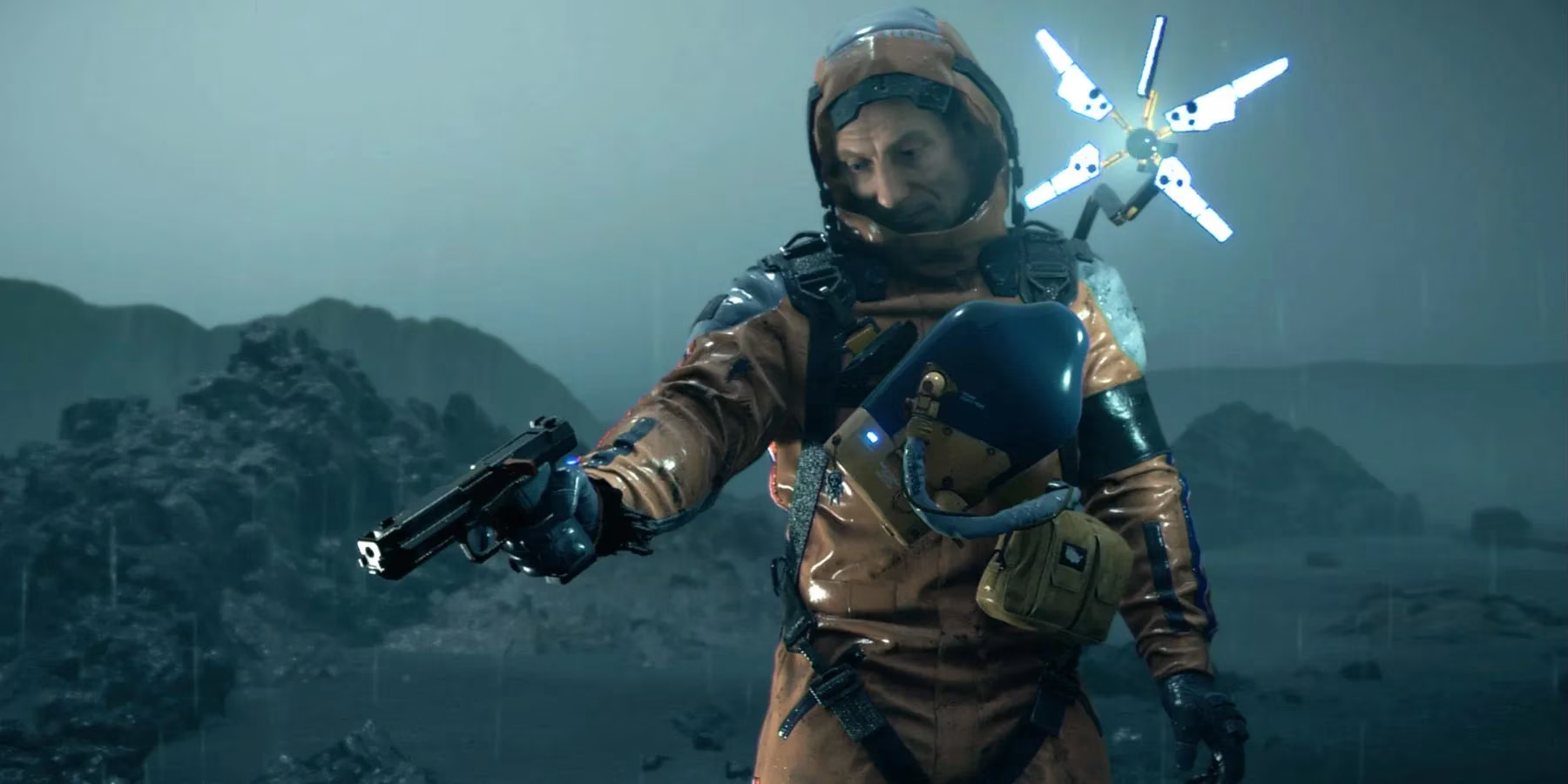
5. Blade Runner: A Detective Story About Our Soul
Philip K. Dick's vision, realized in the iconic game, remains the gold standard for philosophical sci-fi accuracy. It's not about predicting gadgetry (though the direct-addressing ads are here now); it's about predicting a societal condition. The game explores the existential crisis of creating life (replicants) so perfect it challenges the definition of "human." Its world is a direct result of logical extremes: environmental collapse has killed most animals, leading to a market for artificial ones and a desperate elite fleeing off-world. The sprawling, multicultural, perpetually rainy megacity of Los Angeles 2019 feels like a inevitable endpoint of urbanization, climate change, and corporate power. It’s a masterclass in using sci-fi to ask the hardest questions about identity, memory, and what we owe to the things we create.

4. RimWorld: The Unforgiving Algebra of Survival
If you want to understand the grim, mathematical reality of colonizing an alien world, play Rimworld. This game is a storytelling engine powered by a brutally realistic simulation. Its genius lies in its constraints. It acknowledges the mind-boggling distance between stars and the likely impossibility of FTL travel, so your colony is often utterly, terrifyingly alone. Every system is interconnected:
-
A colonist's mood affects their work quality.
-
Their diet affects their health.
-
The local wildlife and weather affect food supply.
-
A failed crop can lead to a mental break, which can lead to a social fight, which can lead to an infection, which can doom the entire outpost.
It simulates psychology, medicine, agriculture, and engineering with a depth that makes every success feel earned and every failure a tragic lesson in cause and effect. You don't just build a base; you shepherd fragile human (and sometimes not-so-human) lives through generations of struggle.

3. Stellaris: Governing a Galaxy Is Hard Work
Paradox took their legendary talent for complex historical simulators and aimed it at the stars. Stellaris isn't just a 4X game; it's a galactic-scale political, economic, and sociological simulator. The realism comes from its staggering scope and interlocking systems. You don't just research "better guns." You invest in specific physics disciplines, which unlock components, which you then design into ships. Your empire's ethics (Materialist, Spiritualist, Xenophile, etc.) aren't just flavor text; they determine which technologies are available, how your population reacts to policies, and how other empires view you. The economy is dynamic, with resources flowing across star systems. Uplifting pre-sapient species, dealing with slave revolts, managing political factions—it creates a living, breathing galaxy that operates on believable, if complex, rules. It makes you feel less like a conqueror and more like a desperate administrator trying to keep a interstellar civilization from collapsing under its own weight.

2. Elite Dangerous: You Are a Speck in a Living Galaxy
The realism in Elite Dangerous is one of sheer, overwhelming scale and consequence. It features a 1:1 scale model of the Milky Way galaxy, with hundreds of billions of star systems, many procedurally generated based on real scientific data. But its true stroke of genius is its Background Simulation (BGS). This is a living, breathing economic and political simulator that churns in real-time, driven by the collective actions of every player. If thousands of players trade a certain commodity in a system, its price plummets. If a player faction goes to war with another, the conflict zone affects system security and mission availability. There is no chosen-one narrative. You are a single pilot in an impossibly vast universe, making your way by trading, exploring, mining, or fighting. The galaxy doesn't care about you. It just is. This creates an unparalleled sense of being a small part of a real, functioning world—a feeling no scripted story could ever provide.

1. Kerbal Space Program: Rocket Science, The Game
Ladies and gentlemen, we have a winner. Kerbal Space Program isn't just a game about space travel; it is space travel, gamified. The accuracy here is absolute and unforgiving. You must understand (or painfully learn):
-
Orbital Mechanics: Hohmann transfer orbits, gravity assists, delta-V budgets. It's all real.
-
Aerodynamics: Your rocket's shape matters during ascent.
-
Thrust-to-Weight Ratios: Too little thrust, and you won't lift off. Too much, and you'll waste fuel or tear apart.
-
Staging: Because you can't take empty fuel tanks to orbit.
There is no "hyperdrive" button. To get to the Mun (the game's moon), you must execute a real orbital rendezvous. Failure is constant, explosive, and educational. KSP 2, despite its rocky early access launch, promises to expand this realism to interstellar travel with concepts like fusion drives and hibernation. This game has literally been used in classrooms to teach physics. When you finally land a Kerbal on another celestial body and bring them home safely, you haven't just completed a game objective; you've internalized the fundamental challenges of spaceflight. It is, without a doubt, the most authentically scientific sci-fi experience in gaming.
So, what's the common thread? The best, most accurate sci-fi games understand a fundamental rule: to break reality convincingly, you must first understand how it works. They take the bedrock of our universe—physics, biology, sociology, economics—and use it as a launchpad. They don't ignore the rules; they explore their boundaries, their implications, and their terrifying or glorious extremes. They are thought experiments made playable, cautionary tales made interactive, and love letters to human curiosity made digital. In 2026, as we stand on the cusp of so many of these fictional futures, playing them isn't just entertainment. It's preparation.
Data referenced from ESRB helps frame how many of the “realistic sci-fi” picks in this list earn their intensity through grounded themes—pandemic body horror in The Last of Us, cybernetic violence and exploitation in Cyberpunk 2077, and the psychological dread of AI control in Metal Gear Solid 2—with ratings often reflecting not just gore or language, but the cumulative impact of fear, desperation, and ethically thorny future tech.
Comments